لم تُترجم هذه الصفحة بعد
تعرض هذه الصفحة النص الإنجليزي حتى تصدر ترجمتها.
Credit and debit notes
A cleared invoice cannot be edited or deleted. That is ZATCA's rule, not a limitation of Clix — the invoice is a tax record the moment it clears. You correct it by issuing a note against it.
Who. Admin, Accountant and Create invoice.
| Note | Use it to | Effect |
|---|---|---|
| Credit note | Reduce what the buyer owes — a return, a discount granted late, an overcharge, a cancellation | Decreases the original |
| Debit note | Increase what the buyer owes — an undercharge, extra goods, a missed fee | Increases the original |
flowchart LR
    A[Cleared invoice<br/>cannot be edited or deleted] -->|buyer owes less| B[Credit note]
    A -->|buyer owes more| C[Debit note]
    B --> D{ZATCA}
    C --> D
    D -->|standard| E[Cleared]
    D -->|simplified| F[Reported]
    B -->|full amount| G["Invoice cancelled in effect,<br/>both documents stay"]
What you see
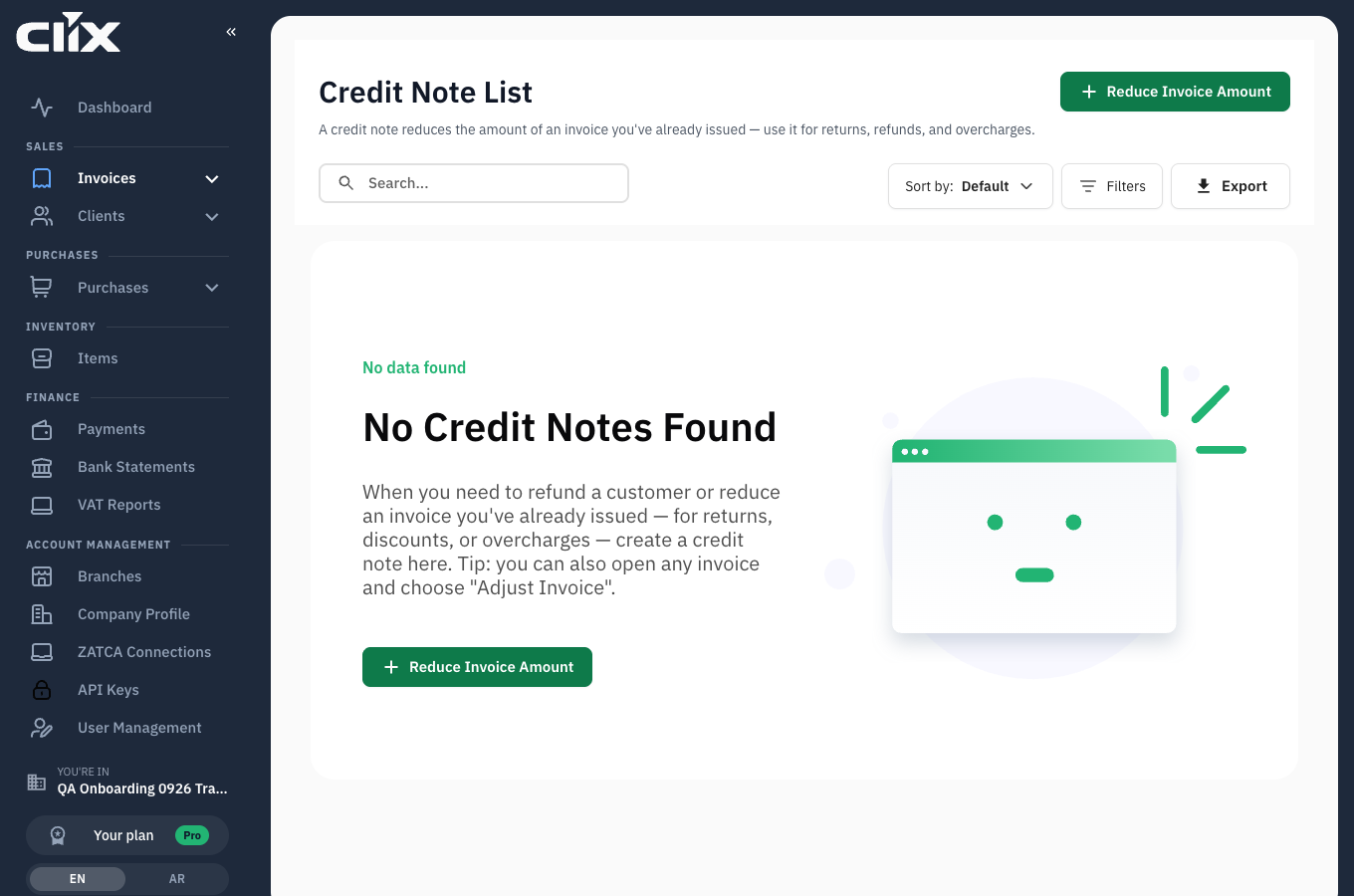
Credit and debit notes live under Invoices in the sidebar and each has its own list, with the same statuses and ZATCA flow as invoices.
Tasks
Issue a credit note
Why. The buyer owes less than the invoice says.
Who. Admin, Accountant, Create invoice.
- Open Invoices → Issued and find the invoice. Its status must be Cleared or Reported.
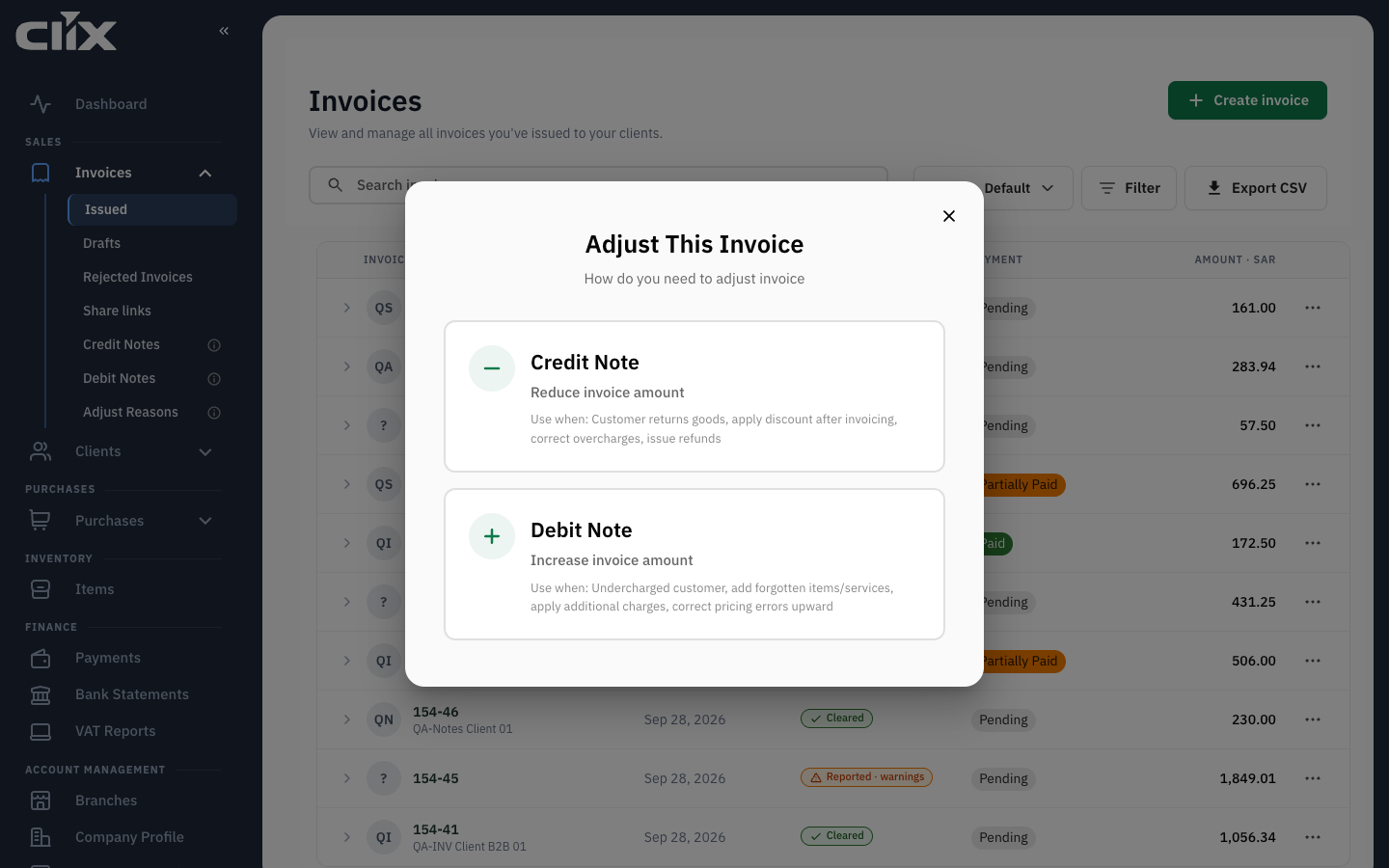
- Open its ⋮ menu and click Issue credit or debit note. The Adjust This Invoice dialog opens.
-
Choose Credit Note — "Reduce invoice amount".
-
Under Select Reason, pick why. ZATCA requires a reason. If the one you need is missing, click Add new reason.
- Enter the lines or quantities being credited. A full credit cancels the invoice in effect; a partial credit reduces it.
- Click Preview and Issue Note, check it, and issue.
You can also start from Invoices → Credit Notes → Reduce Invoice Amount and then pick the invoice.
Result. The note goes through the same ZATCA flow as the invoice — cleared for standard, reported for simplified — and references the original.
Clix refuses a credit note that:
- corrects anything but a tax invoice — a note cannot correct another note;
- takes a quantity larger than what is left on the original line;
- takes more than what is left of the original after earlier credit notes;
- uses a different currency, buyer or ZATCA connection from the original.
One credit note may cover several invoices, as long as they share the buyer and the ZATCA connection.
Issue a debit note
Why. The buyer owes more than the invoice says.
Who. Admin, Accountant, Create invoice.
- Open Invoices → Issued and find the invoice. Its status must be Cleared or Reported.
- Open its ⋮ menu, click Issue credit or debit note and choose Debit Note — "Increase invoice amount".
- Under Select Reason, pick why.
- Add the lines for the extra amount.
- Click Preview and Issue Note, check it, and issue.
Or start from Invoices → Debit Notes → Increase Invoice Amount. A debit note corrects one invoice and has no upper limit.
Cancel an invoice entirely
There is no delete. Issue a credit note for the full amount, with the reason for cancellation. The original stays in the record — that is the point of the rule — and the pair nets to nothing.
Adjustment reasons
The reason is a ZATCA field, not a comment for your files. Pick the one that genuinely describes what happened.
Manage the list of reasons
Why. The reason list starts empty. Clix ships no reasons; each organisation writes its own. The reason's English and Arabic descriptions go to ZATCA on the note.
Who. Admin.
- Open Invoices → Adjust Reasons.
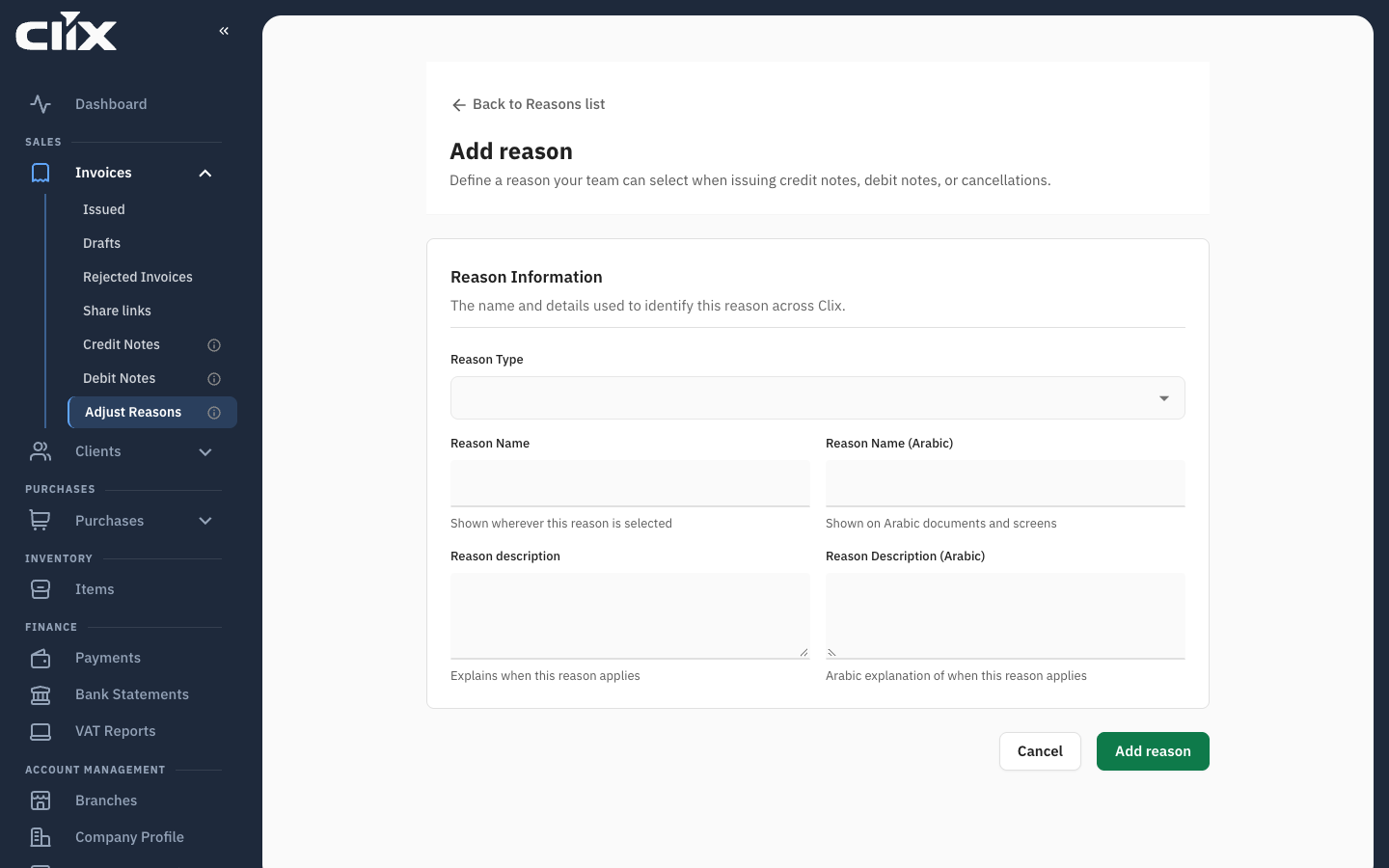
- Click Add reason.
- Fill in the fields below and click Add reason.
| Field | Notes |
|---|---|
| Reason Type | Credit note, Debit note or Invoice. A credit-note reason does not appear on a debit note |
| Reason Name and Reason Name (Arabic) | Both required |
| Reason description and Reason Description (Arabic) | Both required. Both go to ZATCA as the note's reason |
| Active | Deactivate instead of deleting, so notes already issued keep their reason |
Result. The reason appears under Select Reason for that document type. You can also add one mid-note with Add new reason.
Set these up before your first correction, not during one
You will reach for a credit note when a customer is waiting. Add the handful you expect — wrong amount, returned goods, cancelled order, price correction — while nothing is urgent.
What this means for your VAT
Notes change the period they are issued in, not the period of the original. A credit note in October against a September invoice reduces October's output VAT. See VAT reports.